Educational tool
Will my panel take it?
The most common question we get, and the one most often answered badly. Work through the inputs an electrician actually uses and you will understand your own answer rather than being handed one.
- Decided by
- What is electric, not square footage
- Service sizes
- Usually 100, 150 or 200 A
- Real answer
- A calculation on site
The load conversation
Estimate the demand on your service
The honest answer depends on how much of your house is already electric — not on the size of the house, and not on the age of the panel. Work through it here and you will arrive at the conversation knowing what the numbers do.
36A
8,520 VA at 240 V
Comfortable headroom
On these inputs the service has room to spare. Adding a circuit — including a car charger — is very unlikely to need a service change. What can still stop it is physical space in the panel, which is a five-minute look rather than a calculation.
What this is notThis is an estimator built to make a conversation easier, not a load calculation. A real one is done on site against the current code, using your actual equipment nameplates and your actual panel — and it is the only thing an inspector, a utility or a permit will accept. Treat a result here as a reason to ask a question, never as a decision.
Reading it properly
Three things the estimator above cannot know.
It knows what you ticked. It does not know your house, and the gap between those two is where the real answer lives.
Your actual nameplates
Every figure in the tool is a round illustrative number. Two induction ranges can differ by several kilowatts, and a heat pump's rating depends on the model, the backup heat strapped to it and how the installer configured it.
The physical panel
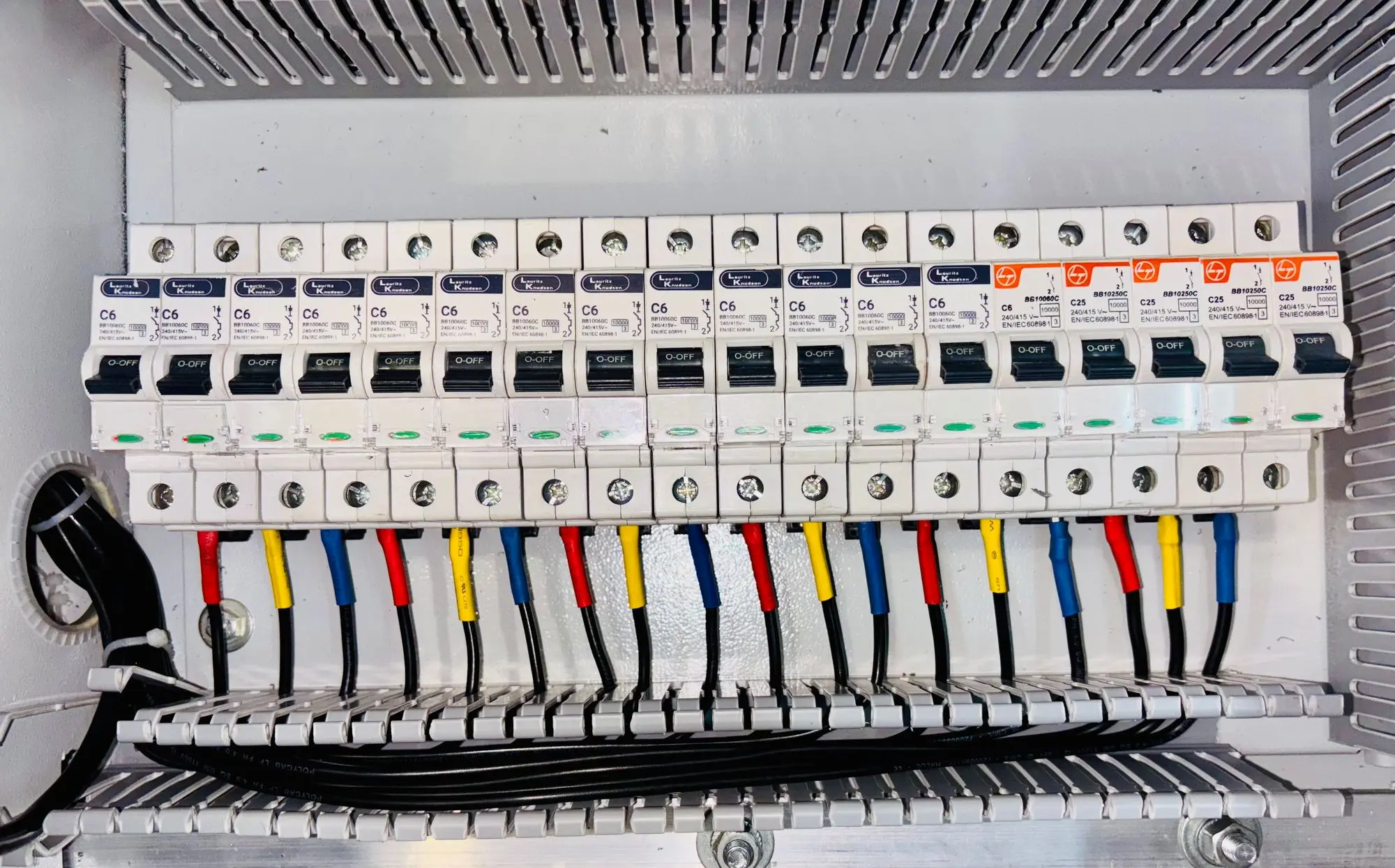
Capacity and space are different problems. A service with plenty of headroom is no use if the panel is physically full, and whether tandem breakers are permitted is decided by the label inside that specific panel door rather than by preference.
Everything between the meter and the breaker
The service conductors, the meter base, the grounding and bonding, and the condition of all of it. A calculation that says yes and a meter base that fails inspection produce the same outcome, which is a job that stops.
About the numbers
Questions the tool tends to raise
What actually is a load calculation?
It is an arithmetic exercise that adds up everything in a house that can draw current, applies the demand factors the code allows — because not everything runs at once — and produces a figure to compare against the service rating. It is what a permit application, a utility and an inspector all want to see before a large new load is added.
Why does the estimator on this page discount most of the total?
Because a house never runs everything simultaneously, and the code recognises that. The optional method takes the first tranche of the total at full value and a fraction of the rest, then adds the larger of heating or cooling at full value on top. This tool follows that shape with round illustrative figures rather than your actual nameplate ratings.
Where do I find my service size?
It is printed on the main breaker at the top of the panel — a two- or three-digit number, usually 100, 150 or 200. Reading it is the one thing on this page you can safely do yourself, because it is printed on the front of a device you do not need to open anything to see.
The estimator says I am tight. Does that mean I need a new panel?
Not necessarily, and this is exactly the band where the real calculation earns its fee. Load management on an EV charger, a smaller charger, or moving one load off electricity solves a lot of houses that a quick look would have sent straight to a service change.
Can I use the result from this page on a permit?
No, and nobody would accept it. It is an educational estimator built to make a conversation easier. A permit needs a calculation done against the code in force locally, on your actual equipment, by someone who has seen your panel.
Book it
Tell us what the house is doing.
Four fields and a sentence. Someone calls you back with a real arrival window — usually the same working day.
(555) 555-0142Monday – Friday: 7:00 am – 6:00 pmSaturday: 8:00 am – 2:00 pmSunday: Urgent calls only
A modern house at dusk with the windows lit from inside