Layers, control, colour
Lighting Design & Installation
Recessed, under-cabinet, exterior and architectural lighting, planned as layers and put on control that people actually use.
- Planned as
- Three layers
- Colour temp
- Consistent per room
- Dimming
- Matched to the driver
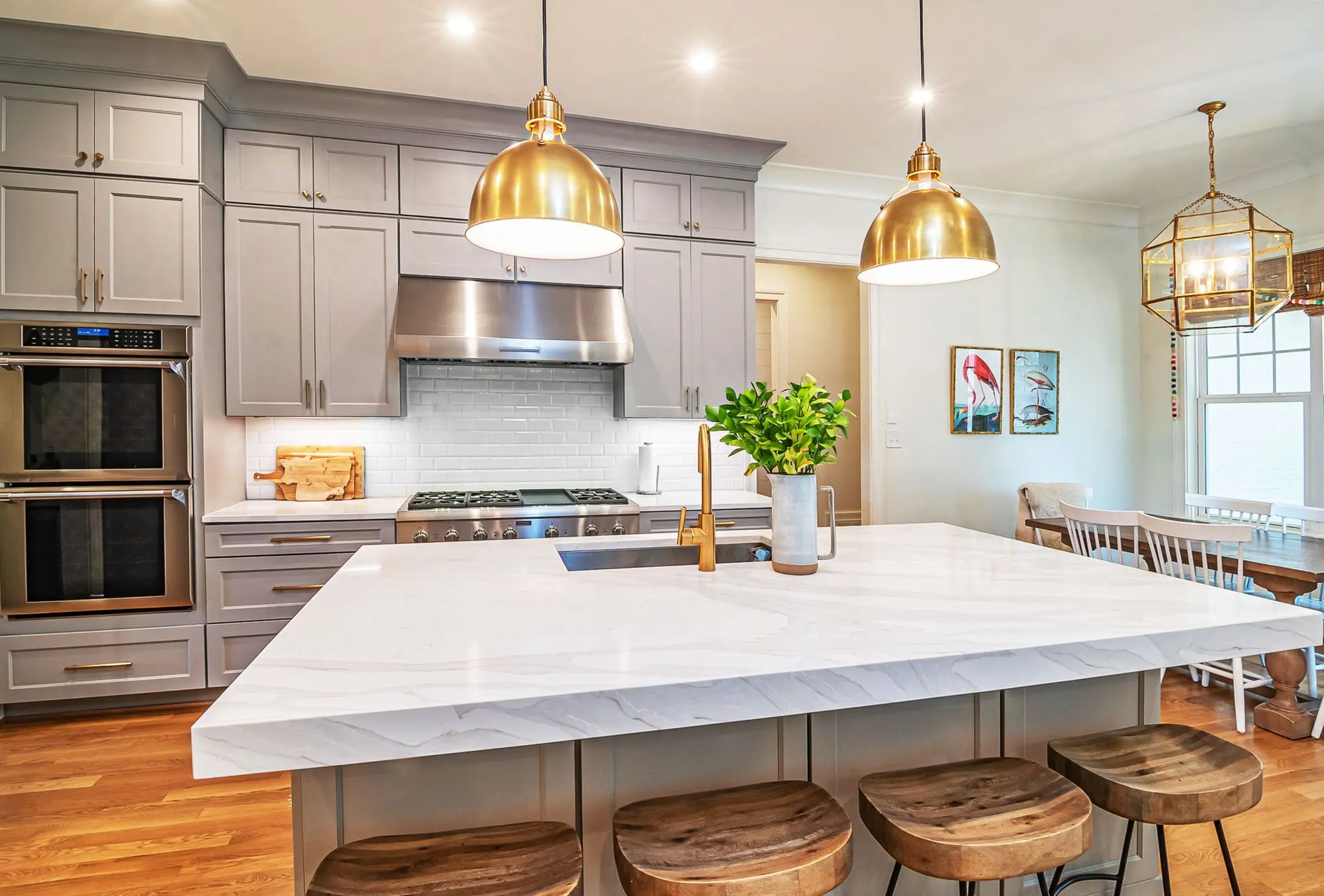
Most rooms are not badly lit. They are lit from one place.
The most common lighting problem in a house is a single fitting in the middle of the ceiling doing every job at once — cooking, reading, eating, and being comfortable at ten at night. No fitting is good at all four.
The fix is layers: something general, something on the work surfaces, and something low and warm for the evening, each on its own control. It is not an expensive idea. It is mostly a question of deciding it before the ceiling is closed up.
- Recessed lighting laid out for the room rather than on a fixed grid
- Under-cabinet and in-cabinet lighting in kitchens, on its own switch
- Dimming that actually works — driver and dimmer matched, not guessed
- Colour temperature kept consistent within a room and chosen deliberately
- Exterior, path, soffit and security lighting on sensible control
- Fixture replacement on high or awkward ceilings
- Switch layouts reworked so the control is where your hand already goes
The parts people regret skipping
Four decisions that separate lighting that works from lighting that is merely installed.
Dimmers are not interchangeable
The flicker and buzz people blame on cheap LEDs is very often a dimmer that does not match the driver. Getting that pairing right at specification time costs nothing and is miserable to fix afterwards.
Colour temperature is a decision
Warm for living space, neutral for work surfaces, and — more important than either — consistent within a sightline. A kitchen with three colour temperatures in it looks wrong and nobody can ever say why.
Where the switches go
Half the value of a lighting plan is switch placement and grouping. If the evening layer needs three switches in two rooms, nobody will ever use it.
Fewer, better fittings
A ceiling does not need to look like a runway. Most rooms we are asked to fill with a dozen downlights are better with six and a decent under-cabinet run.
How this is priced
- In writing before anything starts
- Readings and findings left with you
- Nobody paid a percentage of the invoice
Fixture replacement and small additions are flat-rate per fitting. A full room or a whole-house plan is quoted after a walk-through, and the layout drawing is yours whether or not we do the work. If you are working with a designer or a builder, we will work to their drawing and flag anything on it that will not dim quietly.
Questions we get
About lighting
Why do my new LED lights flicker or buzz?
The most likely reason by far is a dimmer that is not compatible with the LED driver in that fitting — often an older dimmer left in place when the bulbs were changed. It can also be a loose neutral, which is a different and more urgent problem. It is worth having someone check which of those it is.
How many recessed lights does a room need?
Fewer than most layouts assume. It depends on ceiling height, the beam angle of the fitting and what the room is for — a kitchen with good under-cabinet lighting needs far less overhead than one without. We would rather walk the room than answer that with a formula.
Can you add lighting without tearing up the ceiling?
Usually, yes. Remodel-style fittings and careful routing get most jobs done with small, patchable openings. Where a ceiling has blocking, insulation or an awkward joist run, we will tell you before we start what the making-good will look like rather than after.

Stop and call
Burning smell. Scorched outlet. Half the house dark.
The after-hours line rings an electrician who can see the board, not a message service.
- Any smell of burning plastic near an outlet, switch or panel
- Scorch marks, melting or discolouration on a faceplate
- An outlet, switch or breaker that is warm or hot to the touch
- Buzzing, crackling or a sizzling sound from the panel
- A breaker that trips again immediately after being reset
Request this
Tell us what the lighting problem looks like.
Someone calls you back with a real arrival window, usually the same working day.