Trips, overloads, nuisance faults
Breaker & Circuit Problems
Repeat trips, a circuit that cannot take the kettle and the toaster, an AFCI that goes at three in the morning. Each of those means something different.
- Most common cause
- Circuit overload
- Never the fix
- A bigger breaker
- Load readings
- Left with you
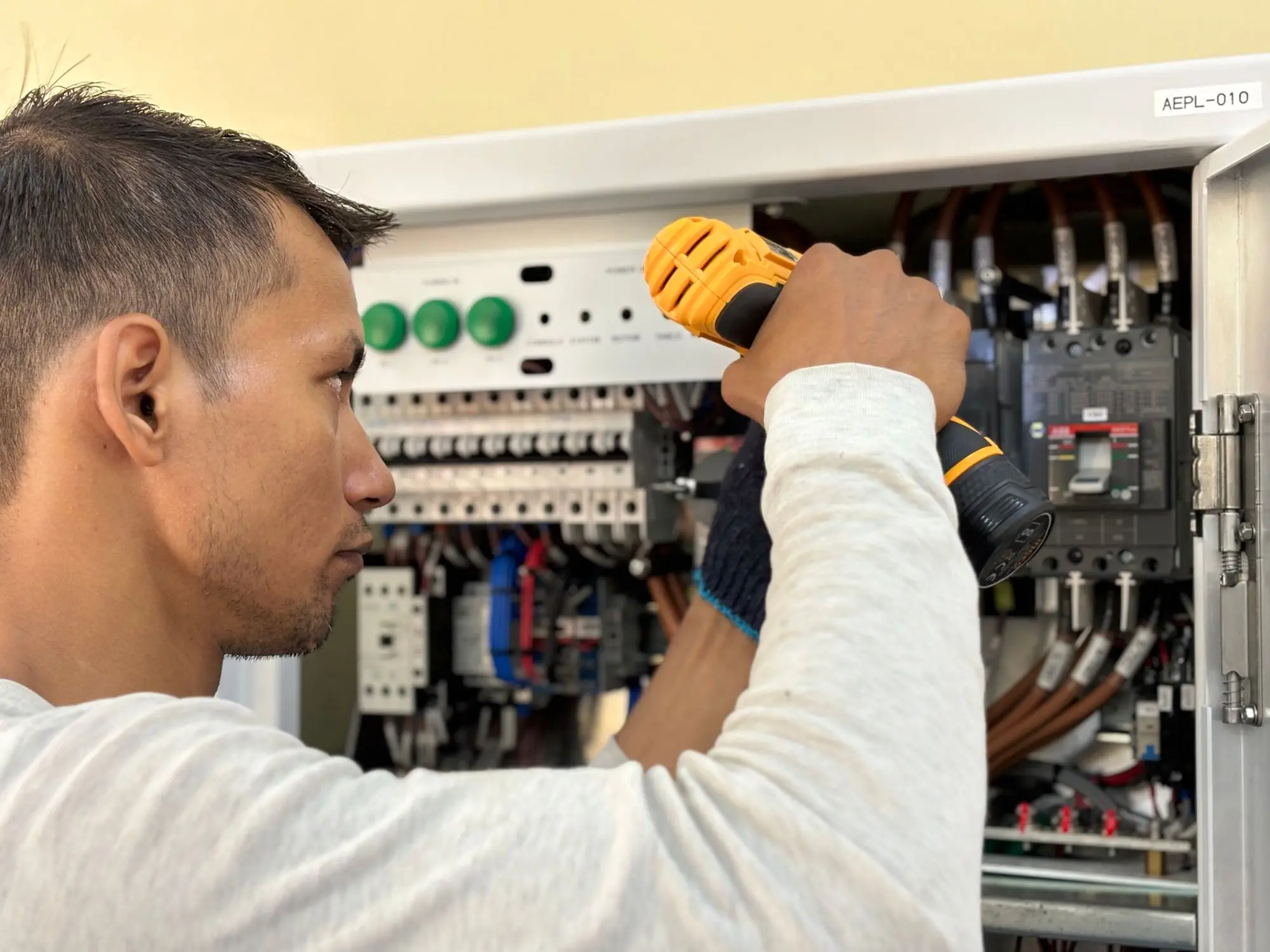
A breaker that trips is not the problem. It is the message.
A breaker exists to open the circuit before the wire behind your wall gets hot enough to matter. When one trips, the interesting question is never "how do I stop it tripping" — it is "what was it protecting me from".
There are broadly three answers: too much load on one circuit, a genuine fault in the wiring or an appliance, or a protective device doing exactly what it was designed to do on a circuit that has always been marginal. Telling those apart takes measurement, not opinion.
- What is actually drawing current on that circuit, measured under real load
- Whether the breaker itself has weakened and now trips below its rating
- Ground faults — the pattern that trips a GFCI rather than a standard breaker
- Arc faults, which is what an AFCI is watching for and why it goes off at odd hours
- A shared neutral doing more work than it was ever meant to
- An appliance with a failing motor or heating element pulling the circuit down
- Whether the circuit was undersized for what the room is now used for
The thing we will not do
There is one shortcut in this trade that shows up constantly, and it is worth being explicit about.
A bigger breaker is not a repair
Fitting a 20-amp breaker to a circuit wired in 14-gauge does stop the tripping. It also removes the protection that was standing between an overloaded cable and the timber it runs through. We will not do it, and if we find it, we will tell you.
Nuisance tripping is a real category
Early AFCI devices genuinely did trip on things that were not faults. That is a legitimate finding — but it is a finding, reached after ruling out the alternatives, not the first thing anyone should reach for.
Sometimes the answer is another circuit
A kitchen wired in 1978 for a kettle and a toaster is now running an air fryer, a microwave and a coffee machine. That circuit is not faulty. It is finished. A new dedicated circuit is usually cheaper than the alternatives.
And sometimes it is the panel
Certain panels made between the 1950s and the 1980s have well-documented problems with breakers that do not trip reliably. If yours is one of them, you will hear it plainly, along with what it would actually cost to deal with.
How this is priced
- In writing before anything starts
- Readings and findings left with you
- Nobody paid a percentage of the invoice
Diagnosis is a flat fee and includes measured load readings on the circuit, left with you on paper. Repairs and new circuits are quoted before the work starts. If the honest answer is "this circuit is fine, you are asking too much of it", you will get that answer for the price of the diagnostic and nothing else.
Questions we get
About breaker & circuit problems
The same breaker trips every few weeks. Is that urgent?
It is worth a call, not a panic — unless it trips again immediately after being reset, or anything nearby is warm, smells hot or looks discoloured. Those three things move it to the front of the queue. An occasional trip on a circuit you know is heavily loaded is usually a capacity conversation.
What is the difference between GFCI and AFCI?
A GFCI watches for current leaking out of the circuit — to earth, to a pipe, to a person — and opens in a fraction of a second. That is the one that protects people, which is why it lives in bathrooms, kitchens and outdoors. An AFCI watches for the electrical signature of arcing inside wiring, which is a fire risk rather than a shock risk. They solve different problems and neither replaces the other.
Can you just add more circuits to my existing panel?
Often yes, if there is physical space and the service has capacity. Both of those are checkable on the visit. If the panel is full, tandem breakers are sometimes an option and sometimes explicitly not permitted on that panel — the label inside the door decides, not preference.
Stop and call
Burning smell. Scorched outlet. Half the house dark.
The after-hours line rings an electrician who can see the board, not a message service.
- Any smell of burning plastic near an outlet, switch or panel
- Scorch marks, melting or discolouration on a faceplate
- An outlet, switch or breaker that is warm or hot to the touch
- Buzzing, crackling or a sizzling sound from the panel
- A breaker that trips again immediately after being reset
Request this
Tell us what the breaker & circuit problems problem looks like.
Someone calls you back with a real arrival window, usually the same working day.