At the panel, not the power strip
Whole-Home Surge Protection
A panel-mounted surge protective device clamps what comes in from outside before it reaches anything. It is one of the cheapest pieces of protection in a modern house.
- Fits
- Most existing panels
- Typical visit
- 1–2 hours
- Layered with
- Point-of-use strips
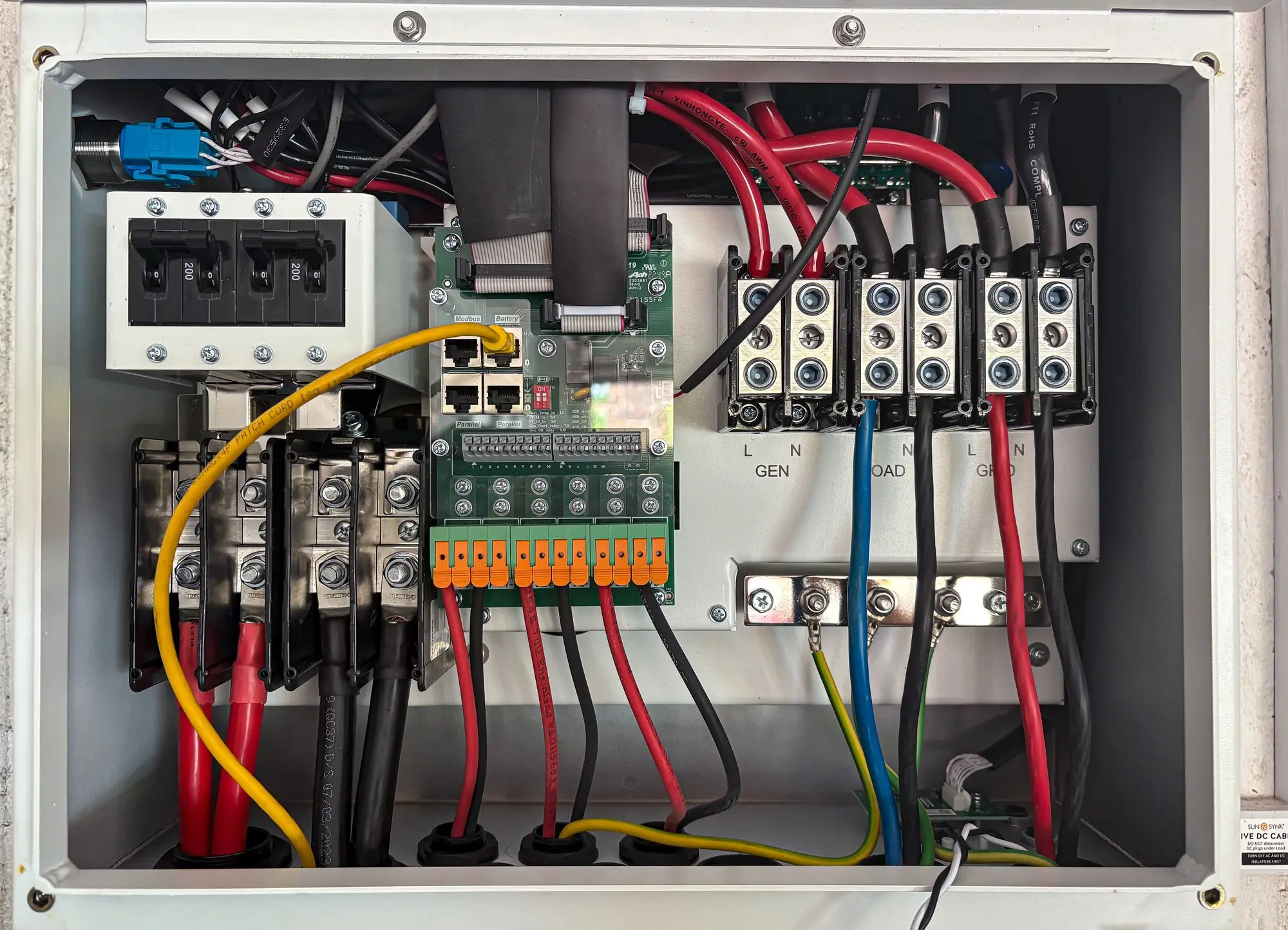
The strip behind your desk protects one desk.
Twenty years ago a surge took out a television. Today it takes out a heat pump control board, an induction range, a car charger, a doorbell, a thermostat and every LED driver in the house — because all of those are now computers.
A whole-home device sits at the panel and clamps the voltage of anything arriving from outside. It is a couple of hours of work and it is genuinely one of the highest-value things you can add to an existing panel.
- Clamps transients arriving on the service — utility switching, nearby strikes, grid events
- Protects everything downstream, including hardwired equipment a power strip never touches
- Installs at the panel, usually on an existing panel without replacing it
- Includes a status indicator, so a device that has done its job and expired is visible
- Does not replace point-of-use protection for sensitive electronics — the two layer
- Does not protect against a direct lightning strike, and no device sold as one does
- Does not fix an existing wiring fault, and will not hide one
Why we bring this up unprompted
It is a small job that we mention on almost every panel visit, for three honest reasons.
The value of what it protects has changed
A house from 1995 had maybe four things worth protecting. A house today has an HVAC control board, a range, a charger, a network, and thirty LED drivers, and every one of them is a circuit board.
The cost has not
It is one of the least expensive additions we make to an existing panel, and it is the same price whether it is fitted alone or during other work — so it is worth mentioning while we are already in there.
It is honest about its limits
These devices are rated, they have a finite absorption capacity, and they expire. The indicator light on the front is not decoration. We will tell you what the rating means and when to look at it.
It layers, it does not replace
Keep the strip behind the desk. The panel device handles what arrives from outside; the strip handles what your own house generates. Both are cheap and they do different jobs.
How this is priced
- In writing before anything starts
- Readings and findings left with you
- Nobody paid a percentage of the invoice
Flat rate, quoted before the visit, and lower when it is fitted during other panel work. Where a panel needs a breaker space to accommodate it, that is included in the quote rather than added on the day.
Questions we get
About surge protection
Is a whole-home surge protector actually worth it?
For a house with a heat pump, an EV charger, an induction range or a lot of LED lighting, yes — those are exactly the loads with electronics that a surge damages, and none of them are on a power strip. For a house that is mostly resistive loads and incandescent bulbs, the case is weaker and we will say so.
Will it protect against a lightning strike?
Not a direct strike, and nothing sold for a house will. What it does protect against is the far more common event: a nearby strike, a utility switching operation or a grid fault sending a transient down the service. Those happen many times a year and are what actually kills equipment.
How do I know if it is still working?
It has an indicator on the front. A device that has absorbed its rated capacity will show that it has expired, and it is a quick swap at that point. It is worth glancing at whenever you are at the panel, and we check it on any subsequent visit.

Stop and call
Burning smell. Scorched outlet. Half the house dark.
The after-hours line rings an electrician who can see the board, not a message service.
- Any smell of burning plastic near an outlet, switch or panel
- Scorch marks, melting or discolouration on a faceplate
- An outlet, switch or breaker that is warm or hot to the touch
- Buzzing, crackling or a sizzling sound from the panel
- A breaker that trips again immediately after being reset
Request this
Tell us what the surge protection problem looks like.
Someone calls you back with a real arrival window, usually the same working day.